Grind Their Bones To Powder Small and With This Hateful Liquor Temper It
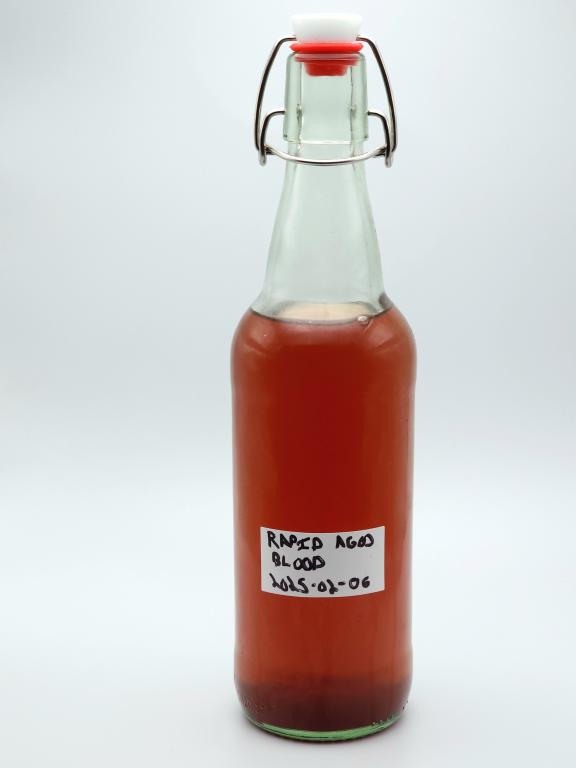
Ever since I heard the words “rapid aged blood” in a cocktail video from Seed Library Shoreditch they have been sitting at the back of my mind like unexploded ordnance, so when C mentioned that they were interested in repeating the drink competition from last year I joked that it would be my core ingredient. When they settled on Shakespeare as the theme it pretty rapidly stopped being a joke, because I found the combination of a terrible play and a suspect ingredient irresistible.
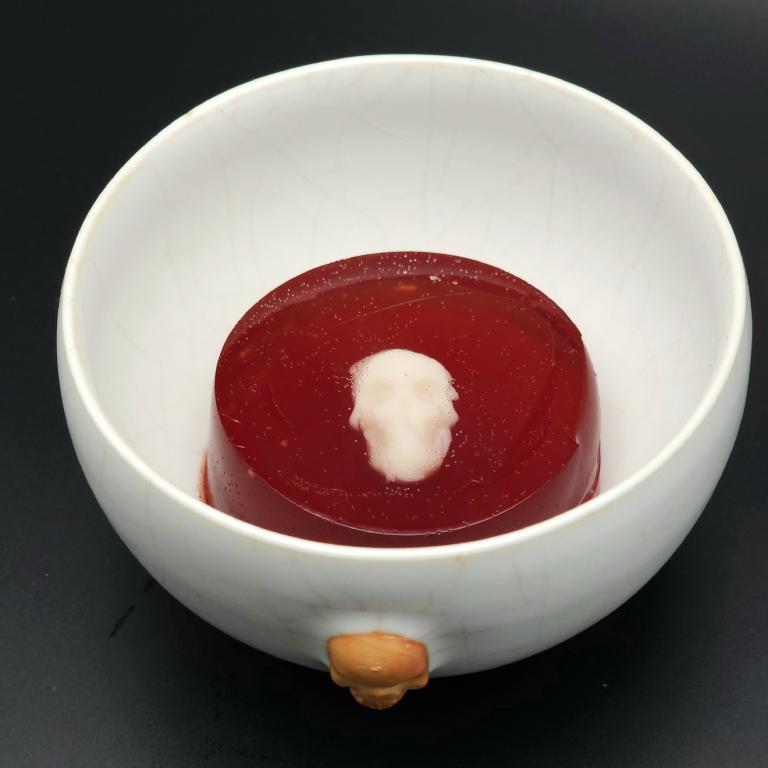
I had a couple of ideas around incorporating bone to match Titus’s use of blood and bone in his revenge pasties, but settled on a jello shot. The flavour profile is inspired by the classic Blood and Sand cocktail, with Scotch swapped for a smoky mezcal and a combination of Campari and blood substituting for the vermouth.
Rapid Aged Blood
I began by dehydrating a pint of beef blood at my dehydrator’s maximum temperature of 165 °F (70 °C) for about 48 hours. I did some small-scale experimentation with rehydrating and extracting flavour from the blood at this point, but the result tasted pretty unaged to me. Combining the remaining powdered blood with a roughly equal volume of granulated sugar in a heavy-bottomed skillet then bunging it in a 350 °F (175 °C) oven and stirring occasionally until the sugar took on some colour seemed like a reasonable next step in encouraging aging. I was pretty happy with how the smell evolved from the too-fresh blood of a butcher’s case to a deeper, darker charnel house smell. With caramel overtones.
I extracted the final product by first soaking the blood and sugar mixture in water, then filtering that through a coffee filter and basically doing a blood pourover by occasionally adding more water in small batches until I had collected about a pint and a half of liquid.
Seed Library describe theirs as tasting like “mineral caramel shortbread” and I can definitely see that (particularly the mineral bit) but I also get a nuttiness and some notes that remind me of chocolate. Don’t get me wrong, it’s not completely pleasant on its own (there’s a definite element of slaughterhouse coming through, particularly on the finish) but the interesting notes outweigh the offputting ones.
Recipe
Skulls (Layer 0)
These are really a decorative element, not something that’s going to contribute much to the flavour.
- 1 sheet gelatin
- 1.5 oz milk
Cut the gelatin into half-inch strips and bloom it in about half of the milk for ten minutes. Heat in a double boiler until the gelatin fully dissolves, then stir in the remaining milk until thoroughly combined. Transfer to skull molds and refrigerate until set (approximately one hour.) Demold carefully.
Mezcal Gelée (Layer 1)
- 5 sheets gelatin
- 4 oz water
- 1/4 cup sugar
Bloom for about ten minutes, then heat in a double boiler until the gelatin fully dissolves. Remove bowl from head and add:
- 2 oz water
- 2 oz mezcal
- 2 tsp acid phosphate (not to be confused with plain phosphoric acid)
If you don’t have acid phosphate it’s probably best not to try to substitute anything in this layer, though dilute citric acid would probably work.
Stir until thoroughly combined. Transfer ~20 ml to each of 12 silicone molds. The sharp-cornered 2-inch cylindrical molds I used were probably not the best choice, it was a very striking result when it worked but far more corners broke off than came out cleanly; hemispheres would maybe have worked out better.
Allow to cool for a few minutes, then float a skull in each mold (if the skull starts melting you didn’t wait long enough.) Refrigerate.
Blood Gelée (Layer 2)
- 5 sheets gelatin
- 3 oz rapid aged blood
- 2 oz blood orange juice, strained to remove pulp
- 2 tbsp sugar
You know the drill: cut, bloom, then melt. Add:
- 2 oz Cherry Heering
- 1 oz Campari
- 2 tsp acid phosphate
Here the clarity matters less so you could try substituting lemon, lime, or yuzu juice for the acid phosphate.
Cool for a few minutes, then transfer ~20 ml to each mold. By now layer one should be set enough that you can carefully pour the new layer on top without commingling the two. Refrigerate until fully set. Demold and serve.